Thăng Long, 1010–1500s CE
Making a medieval capital
How did rulers make their authority convincing? Follow learning, belief, craftsmanship and political memory through six places in Hanoi. Twenty slides, four alternating presenters, and a 13-minute classroom tour.
Start the tourWords, objects
and royal power
Our argument: medieval rulers built authority through education, religious patronage and public symbols, while relying on people and skills beyond the palace. Their claims need testing against evidence.
The historical focus stays within 1010–the 1500s. Present-day photographs locate the sites; later buildings are identified rather than passed off as medieval originals.
A route you can walk
Plan the walk
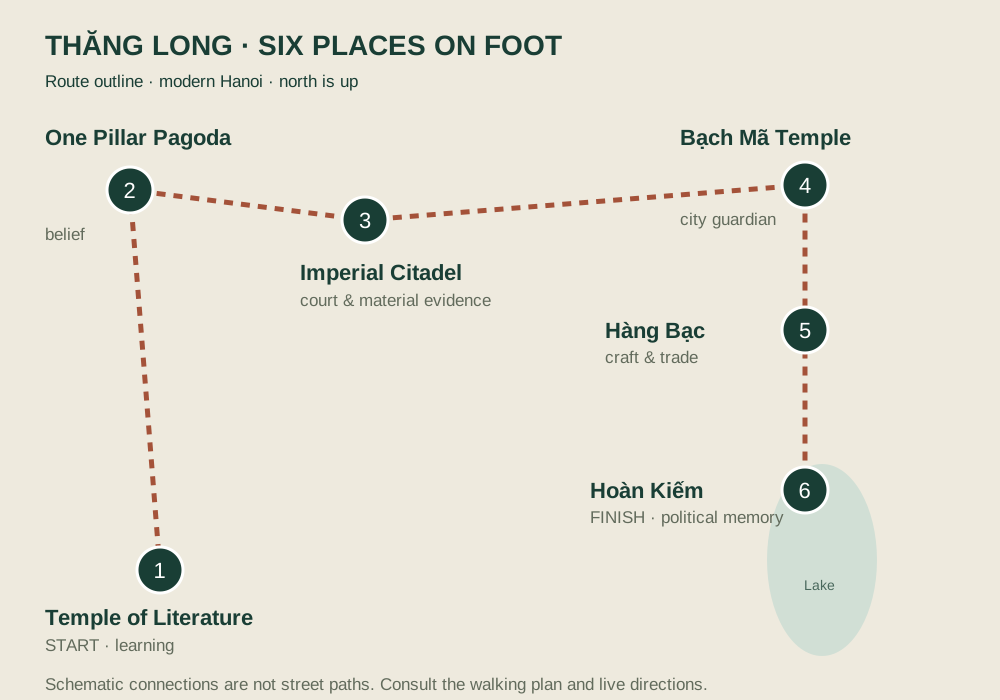
About 5.1–6.3 km between sites, plus roughly 1–1.5 km inside the temple and citadel. Budget 90–120 minutes moving and around 3–4 hours with visits, breaks and crossings.
These are planning estimates, not a measured pedestrian survey. The classroom presentation is separate: 20 × 40 seconds = 13 minutes 20 seconds.
The outline shows visit order. Follow the street corridors below and check each walking link before travel. Tickets, opening hours, traffic and temporary closures can affect access.
The route uses public streets and signed heritage paths. No railway, river crossing or restricted-government shortcut is required. Uneven pavements, curbs and shrine steps mean step-free access is not guaranteed. Check the Văn Miếu visitor information and citadel visitor information before an actual visit.
Explore the six places
Rehearse, then speak naturally
Four voices, one argument
Each person has five slides. Speakers rotate 1 → 2 → 3 → 4 after every slide. Slide 1 is the route outline; slide 20 closes the argument. Aim for about 40 seconds per slide, allowing 10–15 minutes overall.
Do not read a script or the screen. Use the short cues to explain the evidence in your own words. Practice each handoff. Questions are prompts for a brief explanation, not twenty separate audience discussions.
Evidence and handoff notes for all twenty slides
What makes the argument convincing?
Training and recognition
Compare an institution’s founding with the later choice to commemorate its successful scholars.
Claims and material traces
Read the capital edict alongside gates, archaeology and royal sculpture. A ruler’s ambition is not proof of complete control.
Different kinds of evidence
Separate the lake legend, a political proclamation and a modern photograph. Ask what each can establish.
Which source best supports our argument, and where does that source fall short?
Back to the map